Blog/Guides
7 Chatbot Tools for Developers to Evaluate
Developers should compare chatbot tools by observability, tool control, retrieval quality, deployment flexibility, and the failure paths that product demos avoid.

Ren Watanabe
Sep 7, 2026

Developers do not need another chatbot that can complete a perfect prompt in a demo. They need one that can retrieve the right information, call an allowed tool, withstand bad inputs, log what happened, and fail safely. The framework matters more than the brand name.
Last reviewed: 7 September 2026. This article compares implementation layers rather than presenting frameworks, cloud services, and managed products as direct substitutes.
The seven platforms below represent different implementation choices: code-first application frameworks, visual agent builders, cloud platforms, and support products with APIs. Start with the system architecture you need, then test the model and tooling inside it.
The developer shortlist
The test harness every developer should build
Before choosing a platform, create a small evaluation suite. Include representative user requests, retrieved documents, desired tool calls, prohibited actions, expected citations, and adversarial prompts. Version it. Run it before each prompt, model, source, or tool change.
Vercel AI SDK for TypeScript product teams
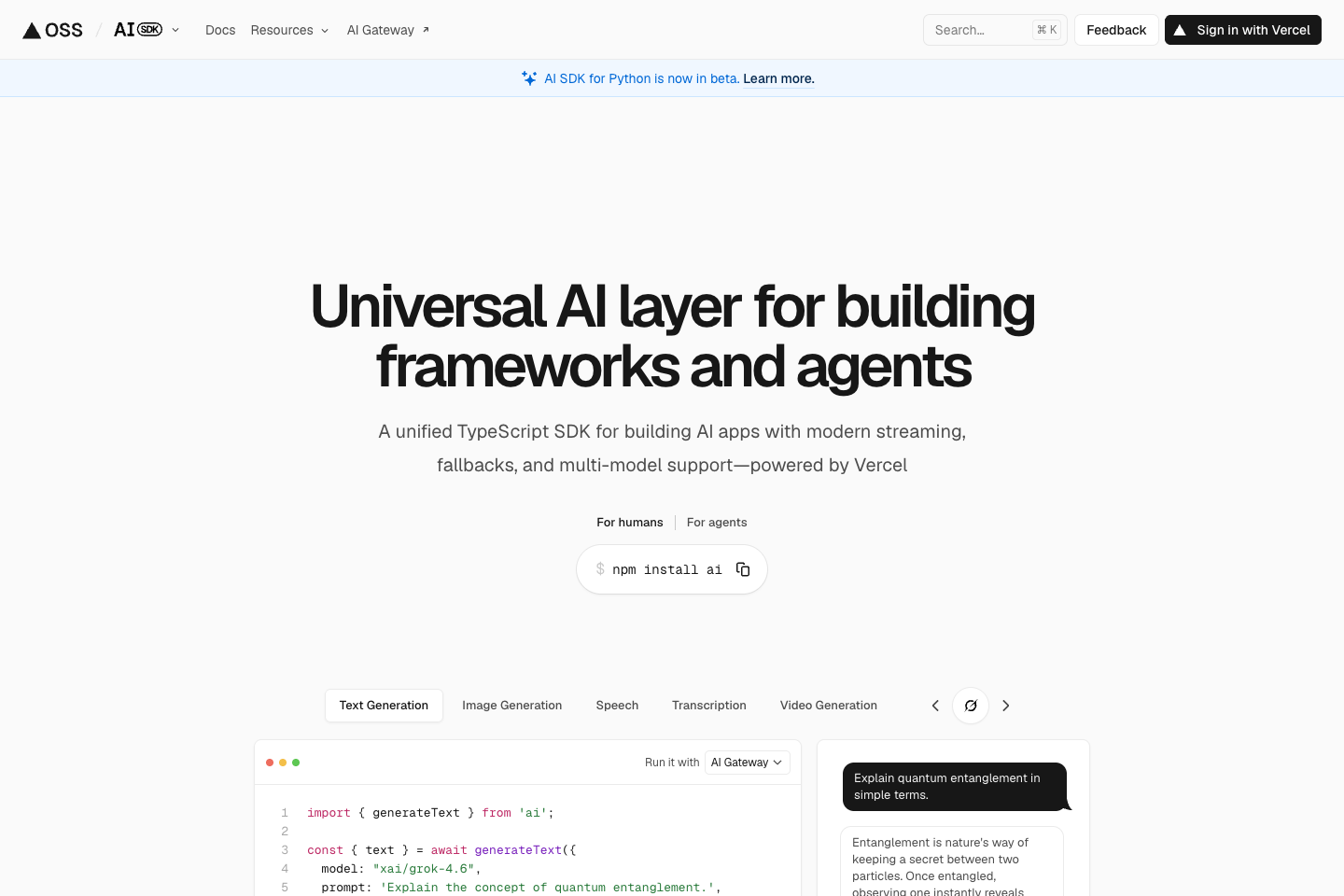
Vercel AI SDK is worth considering when a team wants to build AI features directly into a TypeScript web product with streaming user interfaces and model-provider abstractions. It is an implementation library, not a turnkey support platform. That is the attraction for teams that want full product control.
Choose it when you can own authentication, retrieval, tool execution, logging, rate limits, evaluation, and UX. Do not adopt it because a chat component is quick to render. The hard work sits behind the component.
LangChain and LangGraph for controlled orchestration
LangChain and LangGraph are useful when an application needs custom retrieval, tool orchestration, stateful workflows, and explicit control over how an agent progresses. They can help make complex multi-step logic more legible than a single giant prompt.
Use the graph only when the product has real states and recovery paths. A simple FAQ assistant can become harder to maintain when wrapped in agent orchestration it does not need. Favour the smallest system that can expose and test the important decisions.
Botpress for visual building with extension points
Botpress sits between a packaged bot and a fully code-first framework. Its visual studio can speed up conversational design, while integrations and developer controls support more tailored behaviour. Its pricing model includes model usage considerations, so cost telemetry belongs in the first prototype.
Ask whether flows, tool calls, versioning, environment separation, logs, and deployment fit your engineering practice. If the agent becomes business-critical, it needs the same release discipline as other production software.
Microsoft Copilot Studio for Microsoft ecosystems
Microsoft Copilot Studio is a strong candidate where business data and workflows already use Microsoft platforms. Developers should evaluate it with the administrators who own identity, connectors, Power Platform environments, and data-loss-prevention policy.
The advantage is using established enterprise context. The trap is allowing a low-code project to create unmanaged integrations. Make environment strategy, change approval, and monitoring part of the architecture review.
Vertex AI for Google Cloud applications
Vertex AI is appropriate for teams building AI applications within Google Cloud. It offers a route to models, retrieval patterns, operations, and cloud controls in the same estate. It is not a choice to make solely on model quality; assess deployment, evaluation, identity, data residency, and observability.
Build a narrow vertical slice first. Trace one request from user input through retrieval and tool call to final response. If your team cannot explain every step, adding more agents will amplify uncertainty.
Amazon Bedrock for AWS-native teams
Amazon Bedrock belongs on the shortlist when the data, identity, networking, and operational tooling already live in AWS. Its model access and AWS integrations can reduce architectural friction for an AWS-native application.
The same warning applies: managed model access does not make an agent safe. Validate tool permissions, retrieval boundaries, audit logs, cost controls, and the way a human takes over a failed workflow.
YourGPT for quicker multi-channel deployment
YourGPT can reduce channel-specific implementation work when a team needs knowledge-grounded agents, tools, and deployment across web or messaging channels. It is a product-platform decision rather than a framework decision.
Evaluate its actual integration surface, data handling, tool model, testing workflow, and handoff experience. A faster deployment is valuable when it preserves the controls your engineers would otherwise build.
The deployment model matters more than the demo
Frameworks such as Vercel AI SDK and LangGraph give an engineering team control over application state, interface, evaluation, and runtime behavior. Cloud platforms such as Vertex AI and Amazon Bedrock fit teams whose identity, data, networking, and operations are already anchored in those ecosystems. Managed products such as Botpress and YourGPT can shorten the route to a working channel and knowledge workflow, while accepting more product-defined boundaries.
None is inherently more technical. The relevant question is where your team wants to make a durable engineering investment. If the assistant is a core product feature, own the evaluation and application layer. If the assistant supports a standard business workflow, a managed platform may leave more time for content quality and operations.
An implementation review should include the people who own security and operations, not only the team that built the first prototype. A chatbot can be technically elegant and still fail the first time it receives a real user identity, a stale source, or an action it should reject.
A clear recommendation
Use Vercel AI SDK or LangGraph when the chatbot is a differentiated part of your product and your team is prepared to own the stack. Use Botpress or YourGPT when speed and managed agent infrastructure matter more than owning every layer. Use Copilot Studio, Vertex AI, or Bedrock when cloud and enterprise context should drive the architecture.
The best developer platform is the one your team can test, monitor, secure, and change without guessing.
Questions
Questions developers ask before selecting a stack
Use a framework when the agent experience, backend logic, and evaluation system are differentiated product work your team intends to own. Use a managed product when channel deployment, knowledge operations, and standard handoff patterns matter more than implementing every layer. The correct answer can vary by workflow inside the same company.
Ship one narrow task, approved sources, one or two read-only tools, structured logging, a human handoff, and an evaluation suite. Avoid launching broad action permissions, unconstrained retrieval, and autonomous multi-step work before you can diagnose a single failure.
Log model requests, retrieved context size, tool calls, retries, and failure rates by task. Optimising token cost without measuring useful completion can make an agent cheaper and worse. A cost review should sit beside quality and safety evaluation, not replace it.
For the buyer-side comparison of managed support and agent platforms, see the AI chatbot platform shortlist. For a Google Cloud implementation path, read the Google AI chatbot guide alongside the platform documentation.
Updated Sep 7, 2026.