Blog/Platform
Guru Review for Teams Building a Governed Knowledge Layer
Guru is strongest when employees need cited, permission-aware answers across the tools they already use, not another unowned wiki.

Nalini Desai
Sep 7, 2026

Guru is an internal knowledge and enterprise-search platform for teams that need people and AI tools to find approved answers across the systems where work already happens. Its central promise is not simply storage. Guru positions itself around connected sources, permission-aware search, cited answers, verification, and governance.
Last reviewed: 7 September 2026. This review draws on Guru’s public product material and should be validated in a scoped pilot with the source systems, roles, and access model you actually run.
That makes it a different purchase from a lightweight notes app. It is most relevant when the cost of a stale or inaccessible answer is real: support gives the wrong policy, sales uses an old security response, an operations team cannot find the current process, or an AI assistant draws from material it should not see.
The short verdict
Guru is a strong platform to evaluate for organisations that need a governed knowledge layer across distributed tools and want to show people where an answer came from. It is less compelling for a very small team with one clean documentation space and no need for cross-system search. The product can improve access to knowledge, but it cannot make unsupported, outdated, or ownerless content trustworthy.
What Guru is designed to do
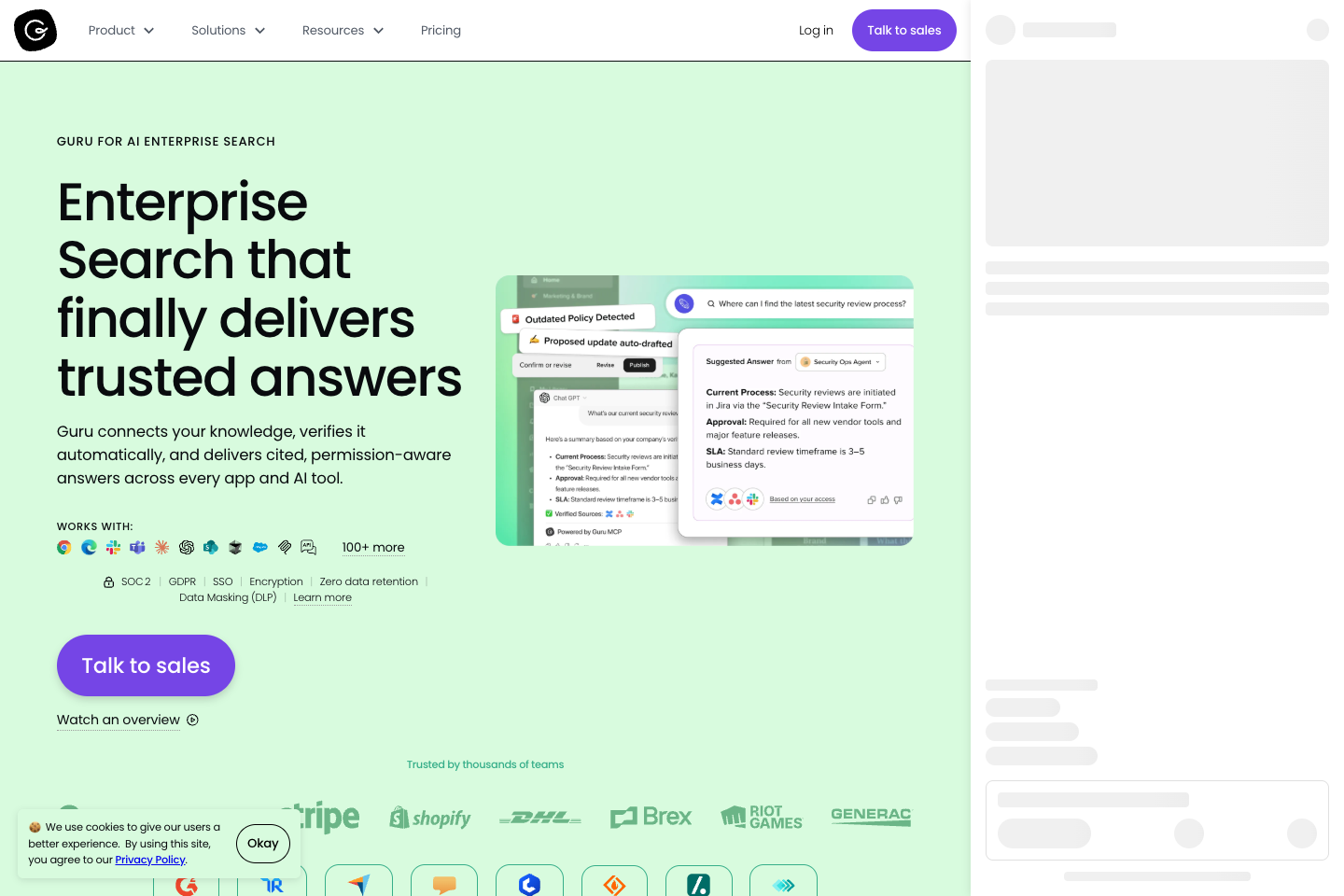
Guru’s enterprise search materials describe permission-aware answers, source citations and lineage, connectors to common workplace systems, verification workflows, and controls intended to keep knowledge current. The important word is “layer.” Guru can connect knowledge without requiring every document to be migrated into a new authoring environment.
Where Guru stands out
The best reason to consider Guru is its emphasis on verification, source-backed answers, and clear ownership rather than treating a published page as permanently correct. A page can be well written and still fail employees if it is out of date, hard to find, or inaccessible in the moment of work. Guru’s product positioning directly addresses that gap.
It is also worth evaluating if a company is introducing AI assistants. An assistant needs an approved retrieval layer, clear permissions, and an audit trail. Otherwise the AI project merely amplifies the existing knowledge mess. Guru describes an MCP-server capability for connecting governed knowledge to AI tools on its enterprise search page; validate exact availability, permissions, and administrator controls for your environment before relying on it.
Where Guru can disappoint
Guru is not a shortcut around knowledge ownership. If product, policy, and support teams cannot agree which source is authoritative, connecting more systems can create a more sophisticated way to surface conflicts. The project needs named owners, a decision about canonical sources, and a process for retiring bad material.
It is also not automatically the right tool for public technical documentation. A developer-docs team may need a publishing workflow and versioned content first. A small internal team may get more value from tightening its existing Notion or Confluence workspace than from adding enterprise search.
How to evaluate Guru fairly
Choose three cross-system questions that employees ask every week. Good examples include a current security answer, a complex product limitation, and an escalation policy. For each question, identify the expected source, an obsolete competing source, and user groups with different permissions.
- Connect only the systems needed for the test.
- Run the questions as a new employee, an experienced specialist, and a user without access to sensitive material.
- Inspect answer accuracy, citations, source freshness, and access control.
- Ask the assigned owner to correct a source and measure how quickly the change becomes discoverable.
- Review logs and administration with security and knowledge owners, not only the project sponsor.
The proof is not that the search box returns text. It is that an employee can act on the answer without opening five tabs or creating a security problem.
Guru versus a wiki
A wiki is where a team may author and organise knowledge. Guru is more relevant when the knowledge you need is distributed across a wiki, drive, support system, CRM, chat, and other business applications. It may include authoring features, but its strategic value lies in making distributed knowledge discoverable, permission-aware, and governable.
If all useful knowledge already lives in one well-maintained wiki, improve that wiki before buying a search layer. If the organisation has many systems and employees routinely ask, “Which page is current?”, Guru becomes more compelling.
Guru versus Glean
Guru and Glean both belong in an enterprise-search conversation. The useful comparison is not a feature bingo card. Compare your connector needs, permission model, knowledge-verification process, AI integration needs, implementation support, and how each performs on the same representative questions.
Guru’s emphasis on verified, governed answers can be attractive to teams trying to establish a trusted knowledge layer. Glean is often considered where broad enterprise search and its knowledge-graph approach are central. Let your source systems and accountability model decide.
Guru versus a conventional knowledge base
A conventional knowledge base is often enough when most important material lives in one place, the writing team has clear owners, and people can find the pages they need. In that environment, adding a broad search layer may hide a simple editorial problem behind new software.
Guru becomes more relevant when employees need to work across a collection of systems and still need a dependable answer. Its documented focus on connectors, permission-aware retrieval, citations, and verification is designed for that operating condition. The trade-off is that the organisation has to take source connections, access design, and verification seriously.
Questions
The questions to ask on the demo
Ask the representative to answer a policy question and show the source, owner, verification status, and last review. A citation without a usable underlying source does not create trust.
Bring a controlled conflict. The platform should surface the right source or make uncertainty visible. It should not blend two incompatible policies into a smooth answer.
Use two user profiles with different access. Test search, AI answers, previews, and shared links. Treat permission testing as a release gate.
Ask what triggers verification, how owners are notified, what happens when they do not act, and how administrators identify stale high-impact content.
Final recommendation
Shortlist Guru when your company needs trustworthy answers across many tools and is prepared to run a knowledge operation with owners and controls. Skip it when the real work is cleaning a single neglected wiki. The platform can make good knowledge easier to use; it cannot create accountable knowledge on its own.
Questions
Questions to settle before procurement
Not necessarily. Guru can sit beside connected sources and help employees retrieve governed knowledge. Decide which system remains canonical for each document type. Replacing an existing wiki only makes sense when authoring, governance, and migration are part of the real problem.
Include one knowledge owner, a security or identity representative, a systems administrator, and users who answer high-value questions. A search pilot without the people who own the sources can prove relevance, but it cannot prove trust or maintainability.
Give critical knowledge a named owner, review cadence, and correction path. Then test the full loop: change a source, check the index, ask the original question again, and confirm users can see what changed.
Updated Sep 7, 2026.